What Are Some Ideasthemes That Were Depicted in the Artmusicliterature of the Harlem Renaissance
| Part of the Roaring Twenties | |
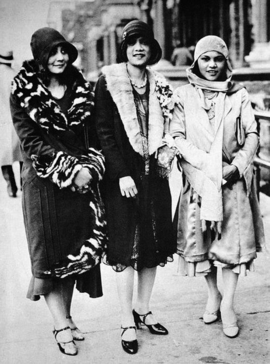 Three African-American women in Harlem during the Harlem Renaissance in 1925 | |
| Appointment | 1918 – mid 1930s |
|---|---|
| Location | Harlem, New York Urban center, United States and influences from Paris, France |
| As well known equally | New Negro Movement |
| Participants | Various artists and social critics |
| Outcome | Mainstream recognition of cultural developments and thought of New Negro |
The Harlem Renaissance was an intellectual and cultural revival of African American music, dance, fine art, fashion, literature, theater, politics and scholarship centered in Harlem, Manhattan, New York Metropolis, spanning the 1920s and 1930s. At the time, it was known equally the "New Negro Movement", named subsequently The New Negro, a 1925 album edited by Alain Locke. The movement also included the new African American cultural expressions across the urban areas in the Northeast and Midwest United States affected by a renewed militancy in the general struggle for civil rights, combined with the Great Migration of African American workers fleeing the racist conditions of the Jim Crow Deep South,[ane] as Harlem was the final destination of the largest number of those who migrated north.
Though it was centered in the Harlem neighborhood, many francophone black writers from African and Caribbean area colonies who lived in Paris were as well influenced by the movement,[ii] [3] [4] [5] which spanned from well-nigh 1918 until the mid-1930s.[six] Many of its ideas lived on much longer. The zenith of this "flowering of Negro literature", equally James Weldon Johnson preferred to call the Harlem Renaissance, took identify between 1924—when Opportunity: A Journal of Negro Life hosted a party for black writers where many white publishers were in omnipresence—and 1929, the yr of the stock-market crash and the get-go of the Great Depression. The Harlem Renaissance is considered to take been a rebirth of the African-American arts.[seven] Many people[ who? ] would contend that the Harlem Renaissance never concluded and has continued to be an important cultural force in the United states through the decades: from the age of footstep piano jazz and dejection to the ages of bebop, stone and whorl, soul, disco and hip-hop.
Groundwork

Until the terminate of the Civil State of war, the majority of African Americans had been enslaved and lived in the Due south. During the Reconstruction Era, the emancipated African Americans, freedmen, began to strive for civic participation, political equality and economic and cultural self-determination. Presently after the end of the Civil War the Ku Klux Klan Act of 1871 gave ascent to speeches by African-American Congressmen addressing this Neb.[eight] By 1875, sixteen African Americans had been elected and served in Congress and gave numerous speeches with their newfound civil empowerment.[9]
The Ku Klux Klan Act of 1871 was followed by the passage of the Civil Rights Act of 1875, part of Reconstruction legislation by Republicans. During the mid-to-late 1870s, racist whites organized in the Democratic Party launched a murderous entrada of racist terrorism to regain political power throughout the South. From 1890 to 1908, they proceeded to pass legislation that disenfranchised nigh African Americans and many poor whites, trapping them without representation. They established white supremacist regimes of Jim Crow segregation in the South and one-party cake voting behind southern Democrats.
Democratic Party politicians (many having been onetime slaveowners and political and military machine leaders of the Confederacy) conspired to deny African Americans their exercise of civil and political rights by terrorizing black communities with lynch mobs and other forms of vigilante violence[10] likewise every bit past instituting a convict labor system that forced many thousands of African Americans back into unpaid labor in mines, on plantations, and on public works projects such as roads and levees. Convict laborers were typically subject to brutal forms of corporal punishment, overwork, and illness from unsanitary conditions. Death rates were extraordinarily high.[11] While a small number of African Americans were able to learn land before long afterwards the Ceremonious War, most were exploited every bit sharecroppers.[12] Whether sharecropping or on their own acreage, most of the black population was closely financially dependent on agriculture. This added another impetus for the Migration: The arrival of the boll weevil. The beetle eventually came to waste 8% of the state'due south cotton yield annually and thus disproportionately impacted this part of America's citizenry.[13] As life in the Due south became increasingly difficult, African Americans began to migrate due north in nifty numbers.
Near of the future leading lights of what was to become known every bit the "Harlem Renaissance" movement arose from a generation that had memories of the gains and losses of Reconstruction subsequently the Civil War. Sometimes their parents, grandparents – or they themselves – had been slaves. Their ancestors had sometimes benefited by paternal investment in cultural capital, including better-than-average didactics.
Many in the Harlem Renaissance were office of the early 20th century Great Migration out of the Southward into the African-American neighborhoods of the Northeast and Midwest. African Americans sought a better standard of living and relief from the institutionalized racism in the Due south. Others were people of African descent from racially stratified communities in the Caribbean who came to the The states hoping for a amend life. Uniting most of them was their convergence in Harlem.
Development
A silent short documentary on the Negro Artist. Richmond Barthé working on Kalombwan (1934)
During the early portion of the 20th century, Harlem was the destination for migrants from around the state, attracting both people from the South seeking work and an educated grade who made the area a center of culture, as well as a growing "Negro" middle course. These people were looking for a fresh start in life and this was a good place to get. The district had originally been developed in the 19th century as an exclusive suburb for the white middle and upper eye classes; its affluent ancestry led to the development of stately houses, grand avenues, and world-form amenities such equally the Polo Grounds and the Harlem Opera House. During the enormous influx of European immigrants in the late 19th century, the once exclusive district was abased by the white eye grade, who moved farther due north.
Harlem became an African-American neighborhood in the early 1900s. In 1910, a large block along 135th Street and Fifth Avenue was bought by various African-American realtors and a church building group.[14] [ citation needed ] Many more African Americans arrived during the First World State of war. Due to the war, the migration of laborers from Europe most ceased, while the war endeavour resulted in a massive need for unskilled industrial labor. The Great Migration brought hundreds of thousands of African Americans to cities such every bit Chicago, Philadelphia, Detroit, and New York.
Despite the increasing popularity of Negro civilisation, virulent white racism, often by more than recent ethnic immigrants, connected to impact African-American communities, even in the North.[15] After the cease of Globe War I, many African-American soldiers—who fought in segregated units such equally the Harlem Hellfighters—came home to a nation whose citizens often did not respect their accomplishments.[16] Race riots and other civil uprisings occurred throughout the US during the Red Summer of 1919, reflecting economical contest over jobs and housing in many cities, besides as tensions over social territories.
Mainstream recognition of Harlem civilization
The first stage of the Harlem Renaissance started in the late 1910s. In 1917, the premiere of Granny Maumee, The Rider of Dreams, Simon the Cyrenian: Plays for a Negro Theater took identify. These plays, written past white playwright Ridgely Torrence, featured African-American actors conveying circuitous human emotions and yearnings. They rejected the stereotypes of the blackface and minstrel bear witness traditions. James Weldon Johnson in 1917 called the premieres of these plays "the most important unmarried event in the entire history of the Negro in the American Theater".[17]
Another landmark came in 1919, when the communist poet Claude McKay published his militant sonnet "If We Must Die", which introduced a dramatically political dimension to the themes of African cultural inheritance and modern urban experience featured in his 1917 poems "Invocation" and "Harlem Dancer". Published under the pseudonym Eli Edwards, these were his start advent in print in the United States after immigrating from Jamaica.[18] Although "If We Must Die" never alluded to race, African-American readers heard its note of defiance in the face of racism and the nationwide race riots and lynchings and so taking place. By the end of the Get-go Earth State of war, the fiction of James Weldon Johnson and the poetry of Claude McKay were describing the reality of contemporary African-American life in America.
The Harlem Renaissance grew out of the changes that had taken place in the African-American community since the abolition of slavery, as the expansion of communities in the North. These accelerated as a outcome of World War I and the great social and cultural changes in early 20th-century Usa. Industrialization was attracting people to cities from rural areas and gave rise to a new mass culture. Contributing factors leading to the Harlem Renaissance were the Great Migration of African Americans to northern cities, which concentrated ambitious people in places where they could encourage each other, and the Showtime World War, which had created new industrial piece of work opportunities for tens of thousands of people. Factors leading to the decline of this era include the Great Low.
Literature
In 1917 Hubert Harrison, "The Male parent of Harlem Radicalism", founded the Liberty League and The Phonation, the first organization and the first newspaper, respectively, of the "New Negro Movement". Harrison's organization and newspaper were political, but too emphasized the arts (his newspaper had "Poetry for the People" and book review sections). In 1927, in the Pittsburgh Courier, Harrison challenged the notion of the renaissance. He argued that the "Negro Literary Renaissance" notion disregarded "the stream of literary and creative products which had flowed uninterruptedly from Negro writers from 1850 to the present," and said the so-called "renaissance" was largely a white invention.[ citation needed ] Alternatively, a writer like the Chicago-based author, Fenton Johnson. who began publishing in the early on 1900s, is called a "forerunner" of the renaissance,[xix] [20] "one of the first negro revolutionary poets".[21]
However, with the Harlem Renaissance came a sense of acceptance for African-American writers; as Langston Hughes put it, with Harlem came the courage "to limited our private nighttime-skinned selves without fear or shame."[22] Alain Locke's album The New Negro was considered the cornerstone of this cultural revolution.[23] The anthology featured several African-American writers and poets, from the well-known, such as Zora Neale Hurston and communists Langston Hughes and Claude McKay, to the bottom-known, similar the poet Anne Spencer.[24]
Many poets of the Harlem Renaissance were inspired to tie in threads of African-American culture into their poems; as a result, jazz poetry was heavily developed during this time. "The Weary Blues" was a notable jazz verse form written past Langston Hughes.[25] Through their works of literature, black authors were able to requite a voice to the African-American identity, equally well every bit strive for a community of back up and acceptance.
Religion
Christianity played a major role in the Harlem Renaissance. Many of the writers and social critics discussed the office of Christianity in African-American lives. For example, a famous poem past Langston Hughes, "Madam and the Minister", reflects the temperature and mood towards religion in the Harlem Renaissance.[26] The cover story for The Crisis mag'south publication in May 1936 explains how of import Christianity was regarding the proposed wedlock of the three largest Methodist churches of 1936. This article shows the controversial question of unification for these churches.[27] The commodity "The Cosmic Church and the Negro Priest", also published in The Crisis, Jan 1920, demonstrates the obstacles African-American priests faced in the Cosmic Church. The article confronts what it saw as policies based on race that excluded African Americans from higher positions in the church.[28]
Soapbox
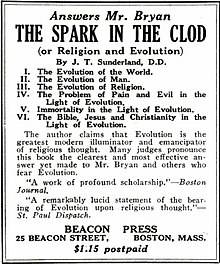
Religion and Evolution Advert
Various forms of religious worship existed during this time of African-American intellectual reawakening. Although there were racist attitudes within the electric current Abrahamic religious arenas many African Americans continued to push towards the practice of a more than inclusive doctrine. For instance, George Joseph MacWilliam presents diverse experiences, during his pursuit towards priesthood, of rejection on the basis of his color and race yet he shares his frustration in attempts to incite action on the part of The Crisis magazine customs.[28]
At that place were other forms of spiritualism expert among African Americans during the Harlem Renaissance. Some of these religions and philosophies were inherited from African beginnings. For case, the organized religion of Islam was nowadays in Africa as early every bit the 8th century through the Trans-Saharan trade. Islam came to Harlem likely through the migration of members of the Moorish Scientific discipline Temple of America, which was established in 1913 in New Jersey.[ commendation needed ] Diverse forms of Judaism were practiced, including Orthodox, Bourgeois, and Reform Judaism, but it was Black Hebrew Israelites that founded their religious belief arrangement during the early 20th century in the Harlem Renaissance.[ citation needed ] Traditional forms of religion acquired from various parts of Africa were inherited and skillful during this era. Some common examples were Voodoo and Santeria.[ citation needed ]
Criticism
Religious critique during this era was found in music, literature, fine art, theater and poetry. The Harlem Renaissance encouraged analytic dialogue that included the open critique and the aligning of current religious ideas.
One of the major contributors to the discussion of African-American renaissance civilization was Aaron Douglas who, with his artwork, also reflected the revisions African Americans were making to the Christian dogma. Douglas uses biblical imagery as inspiration to various pieces of art piece of work but with the rebellious twist of an African influence.[29]
Countee Cullen's poem "Heritage" expresses the inner struggle of an African American between his by African heritage and the new Christian civilisation.[30] A more than severe criticism of the Christian faith can be found in Langston Hughes' verse form "Merry Christmas", where he exposes the irony of religion as a symbol for good and yet a force for oppression and injustice.[31]
Music
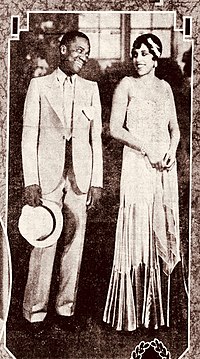
A new mode of playing the piano called the Harlem Pace style was created during the Harlem Renaissance, and helped blur the lines between the poor African Americans and socially elite African Americans. The traditional jazz band was composed primarily of brass instruments and was considered a symbol of the southward, but the piano was considered an instrument of the wealthy. With this instrumental modification to the existing genre, the wealthy African Americans at present had more than admission to jazz music. Its popularity shortly spread throughout the state and was consequently at an all-time high.
Innovation and liveliness were important characteristics of performers in the beginnings of jazz. Jazz performers and composers at the time such as Eubie Blake, Noble Sissle, Jelly Ringlet Morton, Luckey Roberts, James P. Johnson, Willie "The Lion" Smith, Andy Razaf, Fats Waller, Ethel Waters, Adelaide Hall,[32] Florence Mills and bandleaders Duke Ellington, Louis Armstrong and Fletcher Henderson were extremely talented, skillful, competitive and inspirational. They are however considered as having laid great parts of the foundations for future musicians of their genre.[33] [34] [35]
Duke Ellington gained popularity during the Harlem Renaissance. According to Charles Garrett, "The resulting portrait of Ellington reveals him to be not just the gifted composer, bandleader, and musician we have come to know, only also an earthly person with basic desires, weaknesses, and eccentricities."[seven] Ellington did not let his popularity become to him. He remained at-home and focused on his music.
During this period, the musical style of blacks was becoming more and more attractive to whites. White novelists, dramatists and composers started to exploit the musical tendencies and themes of African Americans in their works. Composers (including William Grant Withal, William Fifty. Dawson and Florence Cost) used poems written past African-American poets in their songs, and would implement the rhythms, harmonies and melodies of African-American music—such as dejection, spirituals, and jazz—into their concert pieces. African Americans began to merge with Whites into the classical earth of musical limerick. The first African-American male person to gain wide recognition as a concert artist in both his region and internationally was Roland Hayes. He trained with Arthur Calhoun in Chattanooga, and at Fisk Academy in Nashville. Later, he studied with Arthur Hubbard in Boston and with George Henschel and Amanda Ira Aldridge in London, England. He began singing in public as a student, and toured with the Fisk Jubilee Singers in 1911.[36]
Musical theatre
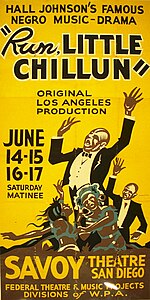
Poster for Run, Little Chillun
According to James Vernon Hatch and Leo Hamalian, all-Black review Run, Little Chillun is considered one of the nigh successful musical dramas of the Harlem Renaissance.[37]
Mode
During the Harlem Renaissance, the black clothing scene took a dramatic turn from the prim and proper. Many immature women preferred- from short skirts and silk stockings to drop-waisted dresses and cloche hats.[38] Adult female wore loose-fitted garments and accessorized with long strand pearl dewdrop necklaces, feather boas, and cigarette holders. The fashion of the Harlem Renaissance was used to convey elegance and flamboyancy and needed to be created with the vibrant dance style of the 1920s in mind.[39] Popular by the 1930s was a trendy, egret-trimmed beret.
Men wore loose suits that led to the after fashion known as the "Zoot", which consisted of wide-legged, high-waisted, peg-pinnacle trousers, and a long coat with padded shoulders and wide lapels. Men also wore wide-brimmed hats, colored socks,[40] white gloves, and velvet-collared Chesterfield coats. During this period, African Americans expressed respect for their heritage through a fad for leopard-skin coats, indicating the ability of the African animal.
The extraordinarily successful black dancer Josephine Bakery, though performing in Paris during the superlative of the Renaissance, was a major mode trendsetter for blackness and white women alike. Her gowns from the couturier Jean Patou were much copied, particularly her stage costumes, which Vogue magazine called "startling". Josephine Baker is also credited for highlighting the "art deco" fashion era after she performed the "Danse Sauvage". During this Paris operation she adorned a skirt made of string and artificial bananas. Ethel Moses was another popular blackness performer, Moses starred in silent films in the 1920s and 30s and was recognizable by her signature bob hairstyle.
Characteristics and themes

Trumpeter Light-headed Gillespie is emblematic of the mixture of loftier class society, popular art, and virtuosity of jazz.
Characterizing the Harlem Renaissance was an overt racial pride that came to exist represented in the idea of the New Negro, who through intellect and production of literature, art, and music could challenge the pervading racism and stereotypes to promote progressive or socialist politics, and racial and social integration. The creation of art and literature would serve to "uplift" the race.
In that location would exist no uniting form singularly characterizing the art that emerged from the Harlem Renaissance. Rather, it encompassed a broad diversity of cultural elements and styles, including a Pan-African perspective, "high-civilization" and "low-culture" or "low-life", from the traditional form of music to the blues and jazz, traditional and new experimental forms in literature such equally modernism and the new grade of jazz poetry. This duality meant that numerous African-American artists came into disharmonize with conservatives in the black intelligentsia, who took issue with certain depictions of black life.
Some common themes represented during the Harlem Renaissance were the influence of the experience of slavery and emerging African-American folk traditions on blackness identity, the effects of institutional racism, the dilemmas inherent in performing and writing for elite white audiences, and the question of how to convey the experience of mod black life in the urban North.
The Harlem Renaissance was ane of primarily African-American involvement. It rested on a support system of black patrons, blackness-owned businesses and publications. All the same, it also depended on the patronage of white Americans, such every bit Carl Van Vechten and Charlotte Osgood Mason, who provided various forms of assistance, opening doors which otherwise might have remained closed to the publication of work exterior the black American community. This back up often took the course of patronage or publication. Carl Van Vechten was ane of the most noteworthy white Americans involved with the Harlem Renaissance. He allowed for assistance to the black American customs because he wanted racial sameness.
There were other whites interested in and so-called "primitive" cultures, as many whites viewed black American culture at that time, and wanted to see such "primitivism" in the piece of work coming out of the Harlem Renaissance. As with most fads, some people may have been exploited in the rush for publicity.
Involvement in African-American lives besides generated experimental simply lasting collaborative piece of work, such as the all-black productions of George Gershwin's opera Porgy and Bess, and Virgil Thomson and Gertrude Stein's 4 Saints in Iii Acts. In both productions the choral usher Eva Jessye was role of the creative team. Her choir was featured in Four Saints.[41] The music world also found white band leaders defying racist attitudes to include the best and the brightest African-American stars of music and song in their productions.
The African Americans used fine art to prove their humanity and demand for equality. The Harlem Renaissance led to more opportunities for blacks to exist published by mainstream houses. Many authors began to publish novels, magazines and newspapers during this time. The new fiction attracted a corking amount of attending from the nation at large. Amidst authors who became nationally known were Jean Toomer, Jessie Fauset, Claude McKay, Zora Neale Hurston, James Weldon Johnson, Alain Locke, Omar Al Amiri, Eric D. Walrond and Langston Hughes.
Richard Bruce Nugent (1906–1987) who wrote "Smoke, Lilies, and Jade" is an important contribution, especially in relation to experimental grade and LGBT themes in the catamenia.[42]
The Harlem Renaissance helped lay the foundation for the post-World War II protestation movement of the Ceremonious Rights movement. Moreover, many black artists who rose to artistic maturity afterwards were inspired past this literary motility.
The Renaissance was more than a literary or artistic motility, equally it possessed a sure sociological development—peculiarly through a new racial consciousness—through ethnic pride, equally seen in the Back to Africa move led by Jamaican Marcus Garvey. At the aforementioned time, a different expression of ethnic pride, promoted by W. E. B. Du Bois, introduced the notion of the "talented tenth". Du Bois' wrote of the Talented Tenth:
The Negro race, similar all races, is going to be saved past its exceptional men. The problem of instruction, then, among Negroes must first of all deal with the Talented Tenth; it is the trouble of developing the best of this race that they may guide the mass away from the contamination and death of the worst.[43]
These "talented tenth" were considered the finest examples of the worth of black Americans as a response to the rampant racism of the period. No particular leadership was assigned to the talented 10th, but they were to be emulated. In both literature and pop word, circuitous ideas such equally Du Bois'south concept of "twoness" (dualism) were introduced (see The Souls of Blackness Folk; 1903).[44] Du Bois explored a divided sensation of one's identity that was a unique critique of the social ramifications of racial consciousness. This exploration was later revived during the Blackness Pride motility of the early 1970s.
Influence
A new Blackness identity

The Harlem Renaissance was successful in that information technology brought the Blackness experience clearly within the corpus of American cultural history. Not just through an explosion of culture, just on a sociological level, the legacy of the Harlem Renaissance redefined how America, and the world, viewed African Americans. The migration of southern Blacks to the north changed the image of the African American from rural, undereducated peasants to one of urban, cosmopolitan sophistication. This new identity led to a greater social consciousness, and African Americans became players on the world stage, expanding intellectual and social contacts internationally.
The progress—both symbolic and real—during this period became a point of reference from which the African-American customs gained a spirit of self-determination that provided a growing sense of both Black urbanity and Blackness militancy, as well as a foundation for the community to build upon for the Civil Rights struggles in the 1950s and 1960s.
The urban setting of quickly developing Harlem provided a venue for African Americans of all backgrounds to appreciate the variety of Blackness life and civilisation. Through this expression, the Harlem Renaissance encouraged the new appreciation of folk roots and culture. For case, folk materials and spirituals provided a rich source for the creative and intellectual imagination, which freed Blacks from the establishment of past condition. Through sharing in these cultural experiences, a consciousness sprung forth in the form of a united racial identity.
However, there was some pressure inside certain groups of the Harlem Renaissance to adopt sentiments of conservative white America in order to be taken seriously by the mainstream. The effect beingness that queer culture, while far-more accustomed in Harlem than nearly places in the state at the fourth dimension, was most fully lived out in the smoky dark lights of bars, nightclubs, and cabarets in the city.[45] It was inside these venues that the dejection music scene boomed, and since it had non notwithstanding gained recognition within popular culture, queer artists used it as a way to express themselves honestly.[45]
Fifty-fifty though in that location were factions inside the Renaissance that were accepting of queer culture/lifestyles, one could still exist arrested for engaging in homosexual acts. Many people, including writer Alice Dunbar Nelson and "The Mother of Blues" Gertrude "Ma" Rainey,[46] had husbands simply were romantically linked to other women as well.[47]
Ma Rainey was known to dress in traditionally male article of clothing and her blues lyrics often reflected her sexual proclivities for women, which was extremely radical at the time. Ma Rainey was besides the first person to introduce blues music into vaudeville.[48] Rainey's protégé, Bessie Smith was some other creative person who used the blues as a mode to express herself with such lines as "When y'all meet two women walking hand in mitt, just expect em' over and try to sympathise: They'll go to those parties – have the lights downward depression – only those parties where women can become."[45]
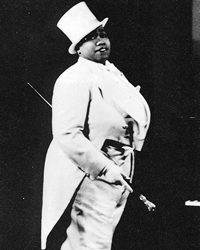
Another prominent blues singer was Gladys Bentley, who was known to cross-dress. Bentley was the society possessor of Clam Business firm on 133rd Street in Harlem, which was a hub for queer patrons. The Hamilton Society in Harlem hosted an annual drag ball that attracted thousands to watch as a couple hundred young men came to dance the night away in drag. Though there were prophylactic havens within Harlem, at that place were prominent voices such every bit that of Abyssinian Baptist Church'south government minister Adam Clayton who actively campaigned against homosexuality.[47]
The Harlem Renaissance gave nascency to the idea of The New Negro. The New Negro motility was an effort to define what it meant to be African-American by African Americans rather than permit the degrading stereotypes and caricatures found in black face minstrelsy practices to do so. There was too The Neo-New Negro movement, which not only challenged racial definitions and stereotypes, merely too sought to challenge gender roles, normative sexuality, and sexism in America in full general. In this respect, the Harlem Renaissance was far ahead of the rest of America in terms of embracing feminism and queer civilisation.[49]
These ideals received some push dorsum as liberty of sexuality, particularly pertaining to women (which during the time in Harlem was known as women-loving women),[46] was seen as confirming the stereotype that black women were loose and lacked sexual discernment. The black bourgeoisie saw this every bit hampering the crusade of black people in America and giving fuel to the fire of racist sentiments around the state. Notwithstanding for all of the efforts by both sectors of white and bourgeois black America, queer culture and artists defined major portions of not but the Harlem Renaissance, but likewise define so much of our culture today. Writer of "The Black Man's Burden", Henry Louis Gates Jr. wrote that the Harlem Renaissance "was surely as gay as information technology was black".[49]
Criticism of the movement
Many critics signal out that the Harlem Renaissance could not escape its history and culture in its attempt to create a new one, or sufficiently dissever from the foundational elements of White, European culture. Often Harlem intellectuals, while proclaiming a new racial consciousness, resorted to mimicry of their white counterparts past adopting their article of clothing, sophisticated manners and etiquette. This "mimicry" may besides be called assimilation, as that is typically what minority members of any social construct must do in guild to fit social norms created by that construct's majority.[l] This could be seen as a reason that the artistic and cultural products of the Harlem Renaissance did not overcome the presence of White-American values, and did not reject these values.[ commendation needed ] In this regard, the creation of the "New Negro" equally the Harlem intellectuals sought, was considered a success.[ by whom? ]
The Harlem Renaissance appealed to a mixed audience. The literature appealed to the African-American middle class and to whites. Magazines such as The Crunch, a monthly journal of the NAACP, and Opportunity, an official publication of the National Urban League, employed Harlem Renaissance writers on their editorial staffs; published poetry and short stories by black writers; and promoted African-American literature through manufactures, reviews, and almanac literary prizes. As of import as these literary outlets were, yet, the Renaissance relied heavily on white publishing houses and white-owned magazines.[51]
A major accomplishment of the Renaissance was to open the door to mainstream white periodicals and publishing houses, although the relationship between the Renaissance writers and white publishers and audiences created some controversy. W. E. B. Du Bois did non oppose the relationship between blackness writers and white publishers, but he was disquisitional of works such as Claude McKay'due south bestselling novel Home to Harlem (1928) for appealing to the "prurient demand[s]" of white readers and publishers for portrayals of black "licentiousness".[51]
Langston Hughes spoke for most of the writers and artists when he wrote in his essay "The Negro Artist and the Racial Mount" (1926) that blackness artists intended to limited themselves freely, no matter what the blackness public or white public thought.[52] Hughes in his writings also returned to the theme of racial passing, but during the Harlem Renaissance, he began to explore the topic of homosexuality and homophobia. He began to utilize disruptive language in his writings. He explored this topic because it was a theme that during this fourth dimension catamenia was not discussed.[53]
African-American musicians and writers were amidst mixed audiences as well, having experienced positive and negative outcomes throughout the New Negro Movement. For musicians, Harlem, New York'south cabarets and nightclubs shined a light on black performers and allowed for blackness residents to enjoy music and dancing. All the same, some of the most popular clubs (that showcased black musicians) were exclusively for white audiences; ane of the near famous white-merely nightclubs in Harlem was the Cotton Club, where popular black musicians like Knuckles Ellington oftentimes performed.[54] Ultimately, the black musicians who appeared at these white-simply clubs became far more successful and became a part of the mainstream music scene.[ citation needed ]
Similarly, blackness writers were given the opportunity to polish once the New Negro Movement gained traction as brusque stories, novels, and poems by blackness authors began taking form and getting into diverse impress publications in the 1910s and 1920s.[55] Although a seemingly skillful way to constitute their identities and culture, many authors note how difficult it was for any of their work to actually go anywhere. Writer Charles Chesnutt in 1877, for example, notes that there was no indication of his race aslope his publication in Atlantic Monthly (at the publisher'south request).[56]
A prominent factor in the New Negro's struggle was that their work had been made out to be "dissimilar" or "exotic" to white audiences, making a necessity for black writers to appeal to them and compete with each other to get their piece of work out.[55] Famous black author and poet Langston Hughes explained that blackness-authored works were placed in a similar fashion to those of oriental or foreign origin, simply being used occasionally in comparison to their white-made counterparts: once a spot for a black work was "taken", black authors had to wait elsewhere to publish.[56]
Certain aspects of the Harlem Renaissance were accepted without debate, and without scrutiny. Ane of these was the future of the "New Negro". Artists and intellectuals of the Harlem Renaissance echoed American progressivism in its religion in democratic reform, in its belief in art and literature as agents of change, and in its almost uncritical belief in itself and its futurity. This progressivist worldview rendered Blackness intellectuals—just like their White counterparts—unprepared for the rude daze of the Neat Depression, and the Harlem Renaissance ended abruptly because of naive assumptions most the centrality of culture, unrelated to economic and social realities.[57]
Works associated with the Harlem Renaissance
- Blackbirds of 1928
- Encyclopedia of the Harlem Renaissance (book)
- The New Negro: The Life of Alain Locke
- Shuffle Along, musical
- Untitled (The Birth), painting
- Voodoo (opera)
- When Washington Was in Vogue
- The Negro in Art
- Taboo (1922 play)
- There'll Be Some Changes Fabricated
Run across as well
- Blackness Arts Movement, 1960s and 1970s
- Black Renaissance in D.C.
- Chicago Black Renaissance
- List of female entertainers of the Harlem Renaissance
- List of notable figures from the Harlem Renaissance
- New Negro
- Niggerati
- William E. Harmon Foundation award
- Cotton Club, nightclub
General:
- Roaring Twenties
- African-American art
- African-American civilisation
- African-American literature
- List of African-American visual artists
Notes and references
Notes
- ^ "NAACP: A Century in the Fight for Liberty" Archived ane August 2013 at the Wayback Machine, Library of Congress.
- ^ "Harlem in the Jazz Age", New York Times, 8 February 1987.
- ^ Cotter, Holland, "ART; A 1920s Flowering That Didn't Disappear", New York Times, 24 May 1998.
- ^ Danica Kirka, Jcu.edu Archived 10 June 2011 at the Wayback Machine
- ^ Kirka, Danica (1 Jan 1995). "Los Angeles Times Interview : Dorothy West : A Vocalization of Harlem Renaissance Talks of By--Only Values the Now". Los Angeles Times.
- ^ Hutchinson, George, "Harlem Renaissance", Encyclopædia Britannica.
- ^ a b "Project MUSE – Modernism, Mass Culture, and the Harlem Renaissance: The Case of Countee Cullen." Project MUSE – Modernism, Mass Civilisation, and the Harlem Renaissance: The Case of Countee Cullen. N.p., northward.d. Spider web. 4 April 2015.
- ^ "Speeches of African-American Representatives Addressing the Ku Klux Klan Bill of 1871" (PDF). NYU Law.
- ^ Cooper Davis, Peggy. "Neglected Voices". NYU Law.
- ^ Wood, Clyde (1998). Development Arrested . New York and London: Verso. ISBN9781859848111.
- ^ Blackmon, Douglas A. (2009). Slavery By Another Proper name: The Re-Enslavement of Black Americans from the Civil War to World State of war II. Anchor.
- ^ Foner, Eric (1988). Reconstruction: America's Unfinished Revolution, 1863–1877. Harper Collins.
- ^ Abdul-Jabbar, Kareem; Obstfeld, Raymond (2007). On The Shoulders of Giants : My Journey Through the Harlem Renaissance. New York: Simon & Schuster. pp. ane–288. ASIN B000NY130O. ISBN978-1-4165-3488-four. OCLC 76168045.
- ^ Dizzying (v December 2016). "The Harlem Renaissance". Boundless.
- ^ Muhammad, Khalil Gibran (2010). The Condemnation of Blackness: Race, Crime, and the Making of Modern Urban America. Cambridge, Massachusetts: Harvard University Printing. pp. 1–xiv. ISBN978-0-674-03597-three.
- ^ "Harlem Hellfighters: Blackness Soldiers in Earth War I". America Comes Live. 5 February 2015. Retrieved sixteen June 2017.
- ^ McKay, Nellie Y., and Henry Louis Gates (eds), The Norton Anthology of African American Literature, New York: Norton, 1997, p. 931.
- ^ McKay, Claude. "Invocation" and "Harlem Dancer," in The Seven Arts ii.6 (October 1917): 741–742. Original page scan bachelor in public domain through The Modernist Journals Project.
- ^ Poets, University of American Poets. "About Fenton Johnson". poets.org . Retrieved xiv August 2021.
- ^ Foundation, Poetry (xiii August 2021). "Fenton Johnson". Poetry Foundation . Retrieved 14 August 2021.
- ^ Lewis, David Levering (1995). The Portable Harlem Renaissance Reader. Penguin Books. p. 752. ISBN978-0-14-017036-8.
- ^ Langston, Hughes (1926). "The Negro Artist and the Racial Mountain". The Nation.
- ^ Locke, Alain (1925). The New Negro. Touchstone. pp. ix.
- ^ Locke, Alain (1925). The New Negro. Touchstone.
- ^ Hughes, Langston (1926). The Weary Blues. New York: Random House.
- ^ Hughes, Langston (1994). The Collected Poems of Langston Hughes . Vintage Classics. pp. 307. ISBN978-0679764083.
- ^ Williams, Robert M.; Carrington, Charles (May 1936). "Methodist Union and The Negro". The Crunch. 43 (v): 134–135.
- ^ a b MacWilliam, George Joseph (Jan 1920). "The Catholic Church building and the Negro Priest". The Crisis. nineteen (3): 122–123. Retrieved 21 December 2013.
- ^ Rampersad, Arnold (Introduction) (1997). Alain Locke (ed.). The New Negro: Voices of the Harlem Renaissance (1st Touchstone ed.). New York, NY: Simon & Schuster. ISBN978-0684838311.
- ^ Cullen, Countee. "Heritage". Poetry Foundation. Archived from the original on 21 December 2013. Retrieved 19 December 2013.
- ^ Hughes, Langston (xiii January 2010). "Merry Christmas". H-Cyberspace: Humanities & Social Sciences Online. New Masses. Retrieved 19 December 2013.
- ^ America, Harlem Renaissance in (5 December 2016). "The Harlem Renaissance". Harlem Renaissance in America Art History – via coreybarksdale.com.
- ^ Boland, Jesse. "Harlem Renaissance Music." 1920s Fashion and Music. Web. 23 November 2009.
- ^ "Harlem Renaissance Music in the 1920s", 1920s Fashion & Music.
- ^ Leonard Feather, "The Book of Jazz" (1957/59), p. 59 ff., Western Book Dist, 1988, ISBN 0818012021, 9780818012020
- ^ Southern, Eileen, Music of Negro Americans: a history. New York: Norton, 1997. Print, pp. 404, 405 and 409.
- ^ Hatch, James Vernon; Hamalian, Leo (1996). Lost plays of the Harlem Renaissance, 1920-1940. Internet Annal. Detroit : Wayne State University Press. ISBN978-0-8143-2580-3.
- ^ West, Aberjhani and Sandra L. (2003). Encyclopedia of the Harlem Renaissance, pp. 105–106; Vogue, 15 February 1926, p. 76.
- ^ Etherington-Smith, Meredith (1983), Patou, p. 83; Vogue, 1 June 1927, p. 51.
- ^ White, Shane and Graham (1998). Stylin': African American Expressive Civilization from Its Beginnings to the Zoot Suit, pp. 248–251.
- ^ "Eva Jessye", University of Michigan, accessed 4 December 2008.
- ^ Nugent, Bruce (2002). Wirth, Thomas H.; Gates, Henry Louis Jr. (eds.). Gay rebel of the Harlem renaissance : selections from the work of Richard Bruce Nugent . Durham [N.C.]: Duke Academy Press. ISBN978-0822328865. OCLC 48691374.
- ^ West.E.B. Du Bois, "The Talented 10th" (text), Sep 1903, TeachingAmericanHistory.org, Ashland Academy, accessed three Sep 2008
- ^ It was possible for blacks to take intellectual discussions on whether black people had a futurity in America, and the Harlem Renaissance reflected such sociopolitical concerns.
- ^ a b c Hix, Lisa (ix July 2013). "Singing the Lesbian Dejection in 1920s Harlem". Collectors Weekly.
- ^ a b Tenoria, Samantha (2006). "Women-Loving Women: Queering Black Urban Space during the Harlem Renaissance" (PDF). The University of California, Irvine (UCI) Undergraduate Research Journal.
- ^ a b Villarosa, Linda (23 July 2011). "The Gay Harlem Renaissance". The Root. Archived from the original on 22 March 2016.
- ^ Garber, Eric. "A Spectacle in Color: The Lesbian and Gay Subculture of Jazz Age Harlem". American Studies at the Academy of Virginia. Academy of Virginia.
- ^ a b Rabaka, Reiland (2011). Hip Hop'south Inheritance From the Harlem Renaissance to the Hip Hop Feminist Movement. Lexington Books. ISBN9780739164822.
- ^ Yayla, Ayşegül. "Harlem Renaissance and its Discontents". Academia. Academia. Retrieved 22 April 2016.
- ^ a b Aptheker, H. ed. (1997), The Correspondence of WEB Dubois: Selections, 1877–1934, Vol. 1, pp. 374–375.
- ^ Rampersad, Arnold (26 Nov 2001). The Life of Langston Hughes: Volume I: 1902-1941, I, Too, Sing America. Oxford Academy Press. ISBN9780199760862 – via Google Books.
- ^ "Project MUSE – Multiple Passings and the Double Decease of Langston Hughes." Project MUSE – Multiple Passings and the Double Decease of Langston Hughes. N.p., n.d. Web. 4 April 2015.
- ^ Davis, John South. (2012). Historical dictionary of jazz. Scarecrow Press. ISBN9780810878983. OCLC 812621902.
- ^ a b Werner, Craig; Golphin, Vincent F. A.; Reisman, Rosemary One thousand. Canfield (2017), "African American Poetry", Salem Press Encyclopedia of Literature, Salem Press, retrieved 21 May 2019
- ^ a b Holmes, Eugene C. (1968). "Alain Locke and the New Negro Move". Negro American Literature Forum. 2 (3): threescore–68. doi:x.2307/3041375. ISSN 0028-2480. JSTOR 3041375.
- ^ Pawłowska, Aneta (2014). "The Ambiguity of African-American Civilisation. The New Negro Art in the interwar menses". Art Inquiry. 16: 190 – via Google Scholar.
References
- Amos, Shawn, compiler. Rhapsodies in Black: Words and Music of the Harlem Renaissance. Los Angeles: Rhino Records, 2000. four Meaty Discs.
- Andrews, William L.; Frances Southward. Foster; Trudier Harris, eds. The Concise Oxford Companion To African American Literature. New York: Oxford Press, 2001. ISBN 1-4028-9296-9
- Bean, Annemarie. A Sourcebook on African-American Performance: Plays, People, Movements. London: Routledge, 1999; pp. vii + 360.
- Greaves, William documentary From These Roots.
- Hicklin, Fannie Ella Frazier. 'The American Negro Playwright, 1920–1964.' PhD Dissertation, Department of Speech, University of Wisconsin, 1965. Ann Arbor: University Microfilms 65-6217.
- Huggins, Nathan. Harlem Renaissance. New York: Oxford University Press, 1973. ISBN 0-19-501665-3
- Hughes, Langston. The Big Sea. New York: Knopf, 1940.
- Hutchinson, George. The Harlem Renaissance in Black and White. New York: Belknap Press, 1997. ISBN 0-674-37263-8
- Lewis, David Levering, ed. The Portable Harlem Renaissance Reader. New York: Viking Penguin, 1995. ISBN 0-14-017036-seven
- Lewis, David Levering. When Harlem Was in Faddy. New York: Penguin, 1997. ISBN 0-14-026334-9
- Ostrom, Hans. A Langston Hughes Encyclopedia. Westport: Greenwood Press, 2002.
- Ostrom, Hans and J. David Macey, eds. The Greenwood Encylclopedia of African American Literature. 5 volumes. Westport: Greenwood Printing, 2005.
- Patton, Venetria K. and Maureen Honey, eds. Double-Take: A Revisionist Harlem Renaissance Anthology. New Bailiwick of jersey: Rutgers University Press, 2006.
- Perry, Jeffrey B. A Hubert Harrison Reader. Middletown, CT: Wesleyan University Press, 2001.
- Perry, Jeffrey B. Hubert Harrison: The Vocalization of Harlem Radicalism, 1883–1918. New York: Columbia University Press, 2008.
- Powell, Richard, and David A. Bailey, eds. Rhapsodies in Black: Art of the Harlem Renaissance. Berkeley: University of California Printing, 1997.
- Rampersad, Arnold. The Life of Langston Hughes. 2 volumes. New York: Oxford University Press, 1986 and 1988.
- Robertson, Stephen, et al., "Hell-raising Houses: Residences, Privacy, and the Surveillance of Sexuality in 1920s Harlem," Journal of the History of Sexuality, 21 (September 2012), 443–66.
- Soto, Michael, ed. Pedagogy The Harlem Renaissance. New York: Peter Lang, 2008.
- Tracy, Steven C. Langston Hughes and the Blues. Urbana: Academy of Illinois Press, 1988.
- Watson, Steven. The Harlem Renaissance: Hub of African-American Culture, 1920–1930. New York: Pantheon Books, 1995. ISBN 0-679-75889-5
- Williams, Iain Cameron. "Underneath a Harlem Moon ... The Harlem to Paris Years of Adelaide Hall". Continuum Int. Publishing, 2003. ISBN 0826458939
- Wintz, Cary D. Black Culture and the Harlem Renaissance. Houston: Rice University Press, 1988.
- Wintz, Cary D. Harlem Speaks: A Living History of the Harlem Renaissance. Naperville, Illinois: Sourcebooks, Inc., 2007
Further reading
- Brownish, Linda Rae. "William Grant Still, Florence Cost, and William Dawson: Echoes of the Harlem Renaissance." In Samuel A. Floyd, Jr (ed.), Black Music in the Harlem Renaissance, Knoxville: University of Tennessee Press, 1990, pp. 71–86.
- Buck, Christopher (2013). Harlem Renaissance in: The American Mosaic: The African American Experience. ABC-CLIO. Santa Barbara, California.
- Johnson, Michael K. (2019) Tin can't Stand Still: Taylor Gordon and the Harlem Renaissance, Jackson: Academy Press of Mississippi, ISBN 9781496821966 (online)
- Rex, Shannon (2015). Whose Harlem Is This, Anyhow? Community Politics and Grassroots Activism during the New Negro Era. New York: New York University Press.
- Lassieur, Alison. (2013), The Harlem Renaissance: An Interactive History Take chances, Capstone Press, ISBN 9781476536095
- Padva, Gilad (2014). "Black Nostalgia: Poetry, Ethnicity, and Homoeroticism in Looking for Langston and Blood brother to Brother". In Padva, Gilad, Queer Nostalgia in Cinema and Pop Civilization, pp. 199–226. Basingstock, UK, and New York: Palgrave Macmillan.
External links
- "A Guide to Harlem Renaissance Materials", from the Library of Congress
- Bryan Carter (ed.). "Virtual Harlem". University of Illinois at Chicago, Electronic Visualization Laboratory.
- "The Budgeted 100th Anniversary of the Harlem Renaissance", past HR historian Aberjhani
- Underneath A Harlem Moon by Iain Cameron Williams ISBN 0-8264-5893-9
- I'd Like to Show Yous Harlem – by Rollin Lynde Hartt, The Independent, Apr, 1921
- Collection: "Artists of the Harlem Renaissance" from the University of Michigan Museum of Art
0 Response to "What Are Some Ideasthemes That Were Depicted in the Artmusicliterature of the Harlem Renaissance"
Post a Comment