How to Read Engine Serial Numbers for Mg
MGB Vehicle Data
CHASSIS (Automobile) NUMBER, VIN & MAJOR Unit Series NUMBERS
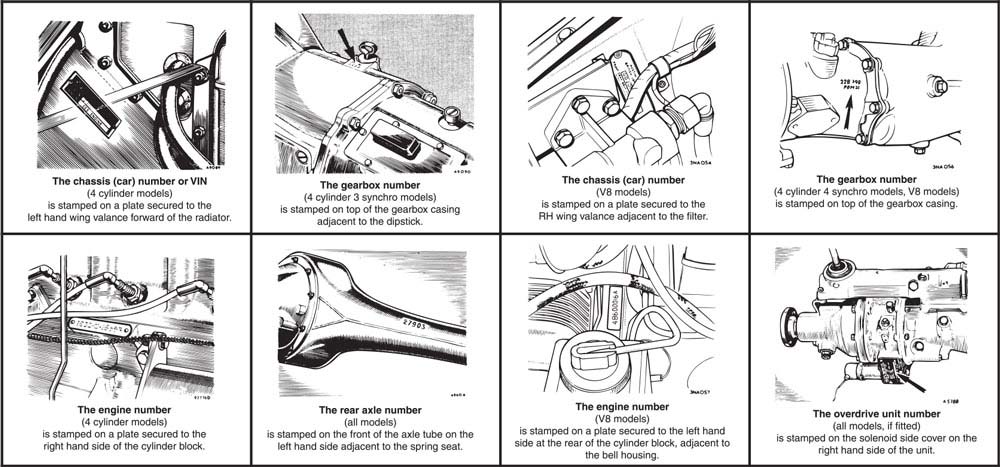
The following illustrations show where the various identification/series numbers are located on the MGB and MGB GT:
MGB ROADSTER 1962-1980
3 Synchro ('Mk I'), 1963 to 1967 Model Years
GHN3-101 to 48766 (Jun. '62 to Oct. '64): 3 master begetting engine with dynamo, positive world, 3 synchromesh gearbox. GHN3-48767 to 138400 (Oct. '64 to Oct. '67): 5 principal bearing engine with dynamo, positive globe, 3 synchromesh manual gearbox.
iv Synchro ('Mk Ii'), 1968 to 1980 Model Years
GHN4-138401 to 187209 (Nov. '67 to October. '69): 5 main begetting engine with alternator, negative earth, 4 synchromesh transmission gearbox or automatic gearbox, concluding cars with chrome grille, last cars with BMC type interior trim with leather seats. GHN5-187210 to 219000 (Oct. '69 to Aug. 'lxx): Black recessed grille, first cars with 'Leylandised' vinyl interior trim, concluding cars with packaway hood or palatial folding (grey frame) hood. GHN5-219001 to 258000 (Aug. 'seventy to Aug. '71): Black recessed grille, terminal cars with 18G series engines, commencement cars with folding (blackness frame) hood. GHN5-258001 to 294250 (Aug. '71 to Aug. '72): Black recessed grille, commencement cars with 18V series engines, first cars with eye console with armrest. GHN5-294251 to 360300 (Aug. '72 to Sep. '74): Chrome/black honeycombe grille, first cars with cooling slots in forepart valance, last cars with chrome bumpers, last cars with overdrive switch on fascia. GHN5-360301 to 410000 (Sep. '74 to Jun. '76): Kickoff cars with prophylactic bumpers, overdrive switch on column stalk, last cars with mechanical radiator fan. GHN5-410001 to 501000 (Jun. '76 to Jun. '79): Overdrive switch on gear lever, first cars with electric radiator fan, commonly chosen 'September 1976 on' models (although the starting time car was built in June, the model was launched in September), last cars with traditional chassis numbers. GV_DJ_AG-501001 to 523001 (Jun. '79 to Oct. '80): Cars with new international VIN (vehicle identification number) type series number
MGB GT 1965-1980
3 Synchro ('Mk I'), 1965 to 1967 Model Years
GHD3-71933 to 139470 (Sep. '65 to Oct. '67): 5 master bearing engine with dynamo, positive globe, 3 synchromesh manual gearbox
four Synchro ('Mk Two'), 1968 to 1980 Model Years
GHD4-139471 to 187840 (Nov. '67 to Sep. '69): v master bearing engine with alternator, negative earth, 4 synchromesh manual gearbox or automatic gearbox, last cars with chrome grille, last cars with BMC type interior trim with leather seats. GHD5-187841 to 219000 (Sep. '69 to Aug. 'lxx): Black recessed grille, first cars with 'Leylandised' vinyl interior trim, horn push button on column stalk. GHD5-219002 to 258003 (Aug. '70 to Aug. '71): Blackness recessed grille, last cars with 18G serial engines, horn push button back on steering cycle. GHD5-258004 to 296000 (Aug. '71 to Aug. '72): Black recessed grille, commencement cars with 18V series engines, offset cars with centre panel with armrest. GHD5-296001 to 361000 (Aug. '72 to Sep. '74): Chrome/black honeycombe grille, beginning cars with cooling slots in forepart valance, concluding cars with chrome bumpers, concluding cars with overdrive switch on fascia. GHD5-361001 to 410350 (Sep. '74 to Jun. '76): Starting time cars with rubber bumpers, overdrive switch on cavalcade stem, concluding cars with mechanical radiator fan. GHD5-410351 to 501035 (Jun. '76 to Jun. '79): Overdrive switch on gear lever, first cars with electrical radiator fan, commonly called 'September 1976 on' models (although the first auto was congenital in June, the model was launched in September), final cars with traditional chassis numbers. GV_EJ_AG-501036 to 523002 (Jun. '79 to October. 'lxxx): Cars with new international VIN (vehicle identification number) blazon series number
MGB GT V8 1972-1976
GD2D1-101 to 2100 (Dec. '72 to Sep. '74): Chrome bumper models. GD2D1-2101 to 2903 (Sep. '74 to Jul. '76): Safety bumper models
VEHICLE IDENTIFICATION
To ensure the parts that you order are correct for your MGB or MGB GT, y'all will need to know most chiefly the chassis number (models up to 1979) or VIN (vehicle Identification Number, 1980 models only). Additionally when ordering engine parts you will also need to know the engine number. Gearbox, overdrive and axle numbers may be required to club parts for those major units.
Chassis (Auto) Number
Chassis number prefixes are equally follows:
GHN3 MGB Roadster, three synchromesh, 1962-67
GHN4 MGB Roadster, 4 synchromesh, 1967-69
GHN5 MGB Roadster, four synchromesh, 1969-79
GHD3 MGB GT (4 cyl), iii synchromesh, 1965-67
GHD4 MGB GT (4 cyl), 4 synchromesh, 1967-69
GHD5 MGB GT (4 cyl), 4 synchromesh, 1969-79
GD2D1 MGB GT V8, 1972-76
VIN (Vehicle Identification Number)
The last half dozen characters of the VIN are the serial number of your car. Notwithstanding, the VIN as well provides y'all with considerably more useful information, most chiefly the model year of your car (nearly changes in production chronicle to model years). The complete VIN can exist broken downward thus:
| First character | G = MG marque |
| Second character | V = MGB model range |
| Third Character | A = UK spec. (Roadster) |
| M = UK spec. (GT) | |
| J = Japan spec | |
| L = Canada spec. | |
| V = Us Federal spec. | |
| Z = United states of america California spec. | |
| Fourth Character | D = Roadster trunk |
| Due east = GT body | |
| 5th Character | J = 1800cc B Serial engine |
| Sixth Character | 1 = RHD steering, manual gearbox |
| ii = LHD steering, manual gearbox | |
| 7th Character | A = 1980 model year |
| 8th Character | G = Abingdon constitute (MG factory) |
| 9th to Fourteenth | 999999 = serial number Characters |
Example: A machine showing GVGEJ1AG 501036 is - MG/MGB/UK spec. (GT)/GT body/1800cc B Serial engine/RHD steering, transmission gearbox/1980 model yr/Abingdon plant (MG manufacturing plant)/serial no. 501036
Engine No., 18G Series, iv Cylinder Engine 1962-71
The engine number will tell yous far more than just the series number of your engine:
| Get-go prefix | 18 = 1800cc |
| Second prefix | G = 3 begetting crank, open crankcase breathing |
| GA = 3 bearing crank, closed circuit breathing | |
| GB = v bearing crank, closed excursion breathing, dynamo | |
| GD = five bearing creepo, closed circuit breathing, alternator | |
| GG = 5 bearing creepo, carb feed breathing circuit, alternator | |
| GF = The states/Canada only | |
| GH to GK = Us/Canada simply | |
| Third prefix (optional) | R = Overdrive |
| Fourth prefix | U = 3 synchro |
| We = 4 synchro | |
| Rc = automatic | |
| 5th prefix | H = High pinch |
| 50 = Low compression | |
| Remaining Digits | Serial number |
Instance: An engine showing 18GD R Nosotros H 6001 is - 1800cc/v bearing crank, closed excursion breathing, alternator/overdrive/iv synchro/high pinch/serial no. 6001
Engine No., 18V Series, 4 Cylinder Engine 1971-80
| First prefix | 18V = 1800cc, in-line |
| Second prefix | 581F = Twin HS4 carbs, non-overdrive, 1971-73 |
| 581Y = Twin HIF4 carbs, non-overdrive, export, 1971-73 | |
| 582F = Twin HS4 carbs, overdrive, 1971-73 | |
| 582Y = Twin HIF4 carbs, overdrive,export, 1971-73 | |
| 583F = Twin HS4 carbs, auto | |
| 583Y = Twin HIF4 carbs, machine, export, 1971- | |
| 779F = Twin HIF4 carbs, non-overdrive, 1974 | |
| 780F = Twin HIF4 carbs, overdrive, 1974 | |
| 846F = Twin HIF4 carbs, non- overdrive, safe bumper | |
| 847F = Twin HIF4 carbs, overdrive, rubber bumper | |
| 584Z to 673Z = USA/Canada but | |
| 836Z to 837Z = USA/Canada but | |
| 797AE to 893AE = USA/Canada/Nihon simply | |
| Third prefix | H = High compression |
| Fifty = Depression pinch | |
| Remaining Digits | Serial number |
Example: An engine showing 18V 847F H 40101 is - 1800cc, in-line/twin HIF4 carbs, overdrive, rubber bumper/high compression/series no. 40101
Engine No., 486 Serial, V8 Engine 1972-76
| First prefix | 486 = 3500cc, 8.25:1 pinch ratio, MGB installation (rear mounted HIF6 carbs, remote oil filter caput) |
| Fourth to Eighth Digits | Serial number |
Example: An engine showing 48601301 is -3500cc, viii.25:i compression ratio, MGB installation/serial no. 01301
MGB & MGB GT 1962-80
BMC's Sports Motorcar for the 1960s that Just Kept Going
Delight forgive the author for pointing this out, but yous take to exist well into middle age now to remember a time when yous didn't see at least a smattering of MGBs turn up at whatever motoring event you chose to nourish.
Now, for what has seemed like forever, the MGB has flown the flag as the iconic Classic British Sports Car. Then, for what seemed like forever, it ruled supreme as the world's most numerous sports car, a title information technology merely eventually lost to Mazda's MX5 some dozen years or so after its 18 year production life concluded in 1980. To this day, one fifth of all the half million MGBs ever built are still effectually, an unmatched survival rate for a car built in that sort of volume.
At different times during its product life the MGB besides spawned the outwardly similar half dozen cylinder MGC and the sublimely entertaining yet still practical MGB GT V8. Thank you to British Motor Heritage, in 1989 (that is, ix years afterwards the last MGB was completed and the MG factory closed) the MGB bodyshell came back into production, ensuring that equally many MGBs as possible would continue to survive well into the next century. This new MGB bodyshell in turn formed the basis of the MG RV8, a new limited edition MG roadster brought almost by Rover Group in the early 1990s to pave the way for the MGF and the return of new MG sports cars.
The MGB proved to be a much loved and long lived car, edifice up from the start a devoted following which is nevertheless as strong today as it was all those years ago. It was as well a pretty basic, moderately robust, moderately performing, very forgiving, inexpensive (to beginning off with, anyway) car that cleverly continued MG's strategy of inviting the masses to safely and affordably experience the fun of being in a sports car. A simple formula that was bang-on target, especially in MG'south biggest market place, the The states.
The iii Synchro MGB: the MGA Replacement
The MGB'southward predecessor, the MGA, had at concluding modernised the image of MG in the mid-1950s, its fully enclothed bodywork contrasting sharply with the pre-war styled square-rigger, ash-framed bodies of the previous MG T Types. The T Types had won and the MGA had kept the hearts of sports car lovers around the earth, the MGA going on to become MG's first really big seller at over 100,000 cars built. Continuing this success story would take skill and a fine agreement of what sports car customers wanted.
The MGB Roadster of 1962 would hitting the nail right on the caput. Intended to be MG's car through the 1960s information technology was modern in style and line. Modernity connected under the peel because the MGB had a monocoque (cocky-supporting, rigid bodyshell) structure, thus departing from the T Type and MGA's by now old school body-on-chassis structure.
The designers and engineers didn't sweep aside all that had gone earlier, though. The MGA'due south greatest forte was its exceptionally sweet handling, as anyone who has driven one will bear witness: rewarding for the more than experienced driver who liked to push button on yet benign and safe for the novice, while still managing to be entertaining for both. The MGB's treatment manners were to be equally close to the MGA's equally possible, despite the radically different structure methods betwixt the ii designs. To ensure this information technology inherited MGA break, steering and weight distribution that were only altered where necessary (in fact many components of the MGB's front and rear interruption get correct back, unaltered, not but to the MGA only even further dorsum to the T Types!).
The fact that through very careful break tuning and spring charge per unit selection the MGB had a softer, much more comfortable ride than the MGA yet still achieved such lovely handling was a primary stroke and won over many new customers to sports automobile driving. It as well ensured that, more than with any other sports car of the fourth dimension, the MGB could be enjoyed rather than endured as an everyday automobile on the one hand yet on the other hand could nonetheless be used effectively (and as it turned out, very successfully) with the minimum of serious modification in sporting competitions and racing.
The gearbox would be a mildly modified version of the MGA's, still with synchromesh on 2nd, tertiary and quaternary gears only (hence the early MGB's vernacular name of 'three Synchro'), but different the MGA or other previous MGs there would be the desirable choice of a Laycock D Type overdrive unit of measurement to usefully increase the transmission's available ratios and the car'due south driving flexibility. The MGA's 'banjo' rear axle was used virtually unchanged.
The engine in the MGB could have been a very unlike thing. Lift the bonnet and look at the wide, only partly utilised infinite in the engine bay and you might conclude that the MGB was designed with a different shape of engine in heed. In fact, a stillborn V4 configuration engine had been seriously considered, but in the cease the BMC B Series in-line four cylinder that had served well in the MGA was used (however the broad engine bay would greatly help engineers some years afterwards when Rover's V8 unit was squeezed in to create the MGB GT V8). To compensate for the increased weight of the MGB, the engine was increased in size (and therefore ability) from the last MGA model's 1622cc up to 1798cc.
Other aspects of the MGA'due south B Series engine fabricated information technology through unchanged to the early MGBs (like the geared drive for the mechanical rev counter and the 3 main bearing crankshaft), though over the years regular improvements brought well-nigh by technical progress or regulations imposed on the auto meant that later MGB engines would share the familiar B Serial silhouette and layout with MGA engines simply nearly every component would actually be different to a lesser or greater extent.
Enter the MGB GT
The 3 Synchro MGB (officially referred to as the 'Mk I' but these days rarely called that by enthusiasts) would be congenital between 1962 and 1967. During that time information technology was field of study to many changes and improvements: overriders and other options were made standard fitment in 1963, new door mechanisms, fuel tank and an electrical rev counter arrived in 1964, a tube blazon Salisbury rear beam replaced the MGA blazon banjo beam in progressively betwixt 1965 and 1967, reversing lights came in for 1966 and so on. The biggest change still came in 1965 with the introduction of the MGB GT.
A hard top had been available as an accessory for the MGB Roadster for a while when a Belgian coachbuilder came up with a very pretty fastback conversion of the MGB in 1963, called the Berlinette. Always rare and valuable, this bonny car was destined to be eclipsed past MG's own 3 door fastback, the MGB GT.
Launched in 1965 and featuring a roof and associated elements seamlessly styled into the MGB's lines by Italian styling house Pininfarina, the MGB GT was arguably not equally pretty as the Berlinette just far better proportioned and styled overall and had the added very practical bonus of a tailgate. In America, the MGB Roadster would always outsell the GT, but in the U.k. and most other major markets the GT quickly outsold its soft top sibling and continued to do and then thereafter.
The four Synchro Mk 2
In tardily 1967 the MGB & MGB GT Mk II were introduced. The big news for the Mk II was fabricated past the manual changes. Now an automatic MGB could be had, which used Borg Warner's robust and basically refined Type 35 transmission - yet it would never sell in big numbers and was dropped from the range past 1974. Transmission cars at last received a new gearbox with synchromesh on all four forrad speeds (hence the 'iv Synchro' moniker) and the overdrive, nonetheless an choice, inverse to the Laycock LH Type. The transmission gearbox was adult aslope a very similar one for the new, bigger engined MGC and Austin iii Litre models and every bit a consequence was markedly stronger than the old 3 Synchro 'box.
Other Mk II changes included negative globe electrics and an alternator as standard, plus new door mechanisms - again. Otherwise things were much as per the previous year, except for Usa-bound cars which received the 'Abingdon Pillow' rubber dashboard and dual excursion brakes; these would exist just the first of many special safety items demanded by the U.s.a. marketplace throughout the rest of the MGB's product life.
British Leyland and All That
While MGB production was progressing through the 1960s, big reorganisations were taking place in the British motor industry which would have far reaching effects on the car. MG's parent visitor, the British Motor Corporation (BMC), merged with Jaguar to form British Motor Holdings (BMH) at the terminate of 1966 and in early 1968 the brusque-lived BMH in turn merged with the Leyland Motor Corporation, owners of Triumph and Rover, to form the British Leyland Motor Corporation (BLMC, later but British Leyland or 'BL').
The trials, tribulations and ultimately the failure followed by nationalisation of British Leyland are well documented and discussed elsewhere, so it'southward sufficient here to simply state that because of the company's woes the funds necessary to develop new models were increasingly hard to come up past and mainstream saloon projects for Austin and Morris soaked up nearly all of the little money that was available at the time. For the MGB a progression of light and inexpensive facelifts on the exterior and trim material changes on the inside would have to exercise for now, in the hope of keeping the car selling in reasonable numbers for as long as information technology took until funds for a replacement model became available.
The MGB GT V8
A small but very bright ray of sunshine shone from MG in 1973 when the MGB GT V8 was introduced. As previously mentioned, the engine bay seemed perfectly sculpted to take a Vee configuration engine and with Rover at present in the same organization there was an opportunity to develop at low cost an MGB fitted with Rover'due south powerful, lite alloy V8. The MGB GT V8 (always the GT bodystyle was used) was fast, powerful, loaded with torque and because the engine was so lite despite its size, the MGB'due south legendary treatment was preserved too.
It was the perfect MGB, except... MG couldn't get agree of plenty engines from Rover to build the cars and when they did build them, BL policy dictated that they would be priced so that they didn't torpedo the sales of Triumph models of like operation. Which meant that the MGB GT V8 toll far too much to purchase. Then the Arab oil crisis of late 1973 quadrupled the price of petrol overnight, ensuring very few people could afford to run a motorcar with a thirsty engine, equally Rover's V8 was perceived to be. When information technology could have and should accept hugely bolstered MG's sales figures and image, the MGB GT V8 became instead a minor sales curiosity, limping forth for ii and a one-half years in the showrooms and selling merely 2600 cars. Today of course the story is dissimilar and the MGB GT V8 is very highly valued and revered, as it always should take been.
The Safe Bumper Models
MG continued to await for BL'south fiscal health to ameliorate sufficiently to permit the development of a replacement for the MGB (in the end the wait would be in vain, the factory closing at the end of MGB product in 1980). Meanwhile the 4 cylinder MGB carried on in production through the mid and after 1970s, seemingly becoming more and more an anachronism. The grafting on of safety bumpers and the raising of the MGB's ride height (thus compromising that lovely treatment) to meet forthcoming rubber legislation in the center of the decade had seemed for a while to be the concluding straw only amazingly the automobile kept on selling despite these apparent aesthetic and dynamic handicaps, admitting in steadily declining numbers.
Actually, the grapheme of the MGB changed as information technology got older only critics at the fourth dimension didn't see whatsoever of the positive aspects of the character alter; they but saw what looked like a sports car long past its sell-by date with middle historic period spread and less than sports carlike performance that simply shouldn't be on sale any more. In many ways they were right, likewise: remember the first Volkswagen Golf GTIs were on sale a yr or ii before the MGB ceased production and were available at a similar showroom price.
Nevertheless, the passage of time has mellowed those critics' comments and allowed the rubber bumper MGB to be viewed in a much more than favourable light. It's now very credible that the rubber bumper MGB is a petty less of a sports automobile and more of a relaxed tourer with an endearingly classic retro edge to it - and actually it's pretty good at the task of being a tourer, too. Even those rubber bumpers themselves now accept their admirers! A late 1970s MGB or MGB GT with dual circuit brakes, straight acting servo, bullet-proof gearbox and overdrive, more than modern switches and controls, element of group vii headlamps and electric radiator fan makes for a very easy to employ, reliable and practical classic that can yet - some 50-odd years later on the MGB was first introduced - be treated as enjoyable and safe everyday transport.
MGB Vehicle Information
CHASSIS (CAR) NUMBER, VIN & MAJOR UNIT SERIAL NUMBERS
The following illustrations show where the various identification/serial numbers are located on the MGB and MGB GT:
MGB ROADSTER 1962-1980
3 Synchro ('Mk I'), 1963 to 1967 Model Years
GHN3-101 to 48766 (Jun. '62 to Oct. '64): 3 main bearing engine with dynamo, positive earth, 3 synchromesh gearbox. GHN3-48767 to 138400 (Oct. '64 to Oct. '67): 5 main bearing engine with dynamo, positive earth, 3 synchromesh manual gearbox.
iv Synchro ('Mk Ii'), 1968 to 1980 Model Years
GHN4-138401 to 187209 (Nov. '67 to Oct. '69): 5 main bearing engine with alternator, negative world, 4 synchromesh manual gearbox or automatic gearbox, last cars with chrome grille, concluding cars with BMC type interior trim with leather seats. GHN5-187210 to 219000 (Oct. '69 to Aug. 'lxx): Black recessed grille, commencement cars with 'Leylandised' vinyl interior trim, last cars with packaway hood or palatial folding (grey frame) hood. GHN5-219001 to 258000 (Aug. '70 to Aug. '71): Black recessed grille, last cars with 18G series engines, commencement cars with folding (black frame) hood. GHN5-258001 to 294250 (Aug. '71 to Aug. '72): Black recessed grille, first cars with 18V series engines, showtime cars with centre console with armrest. GHN5-294251 to 360300 (Aug. '72 to Sep. '74): Chrome/black honeycombe grille, first cars with cooling slots in front valance, last cars with chrome bumpers, last cars with overdrive switch on fascia. GHN5-360301 to 410000 (Sep. '74 to Jun. '76): First cars with rubber bumpers, overdrive switch on column stem, terminal cars with mechanical radiator fan. GHN5-410001 to 501000 (Jun. '76 to Jun. '79): Overdrive switch on gear lever, first cars with electric radiator fan, usually called 'September 1976 on' models (although the outset auto was built in June, the model was launched in September), final cars with traditional chassis numbers. GV_DJ_AG-501001 to 523001 (Jun. '79 to October. '80): Cars with new international VIN (vehicle identification number) blazon series number
MGB GT 1965-1980
3 Synchro ('Mk I'), 1965 to 1967 Model Years
GHD3-71933 to 139470 (Sep. '65 to Oct. '67): v main bearing engine with dynamo, positive world, iii synchromesh manual gearbox
4 Synchro ('Mk II'), 1968 to 1980 Model Years
GHD4-139471 to 187840 (Nov. '67 to Sep. '69): 5 chief begetting engine with alternator, negative earth, iv synchromesh manual gearbox or automatic gearbox, concluding cars with chrome grille, last cars with BMC type interior trim with leather seats. GHD5-187841 to 219000 (Sep. '69 to Aug. '70): Blackness recessed grille, kickoff cars with 'Leylandised' vinyl interior trim, horn push on cavalcade stalk. GHD5-219002 to 258003 (Aug. '70 to Aug. '71): Blackness recessed grille, final cars with 18G series engines, horn push back on steering bike. GHD5-258004 to 296000 (Aug. '71 to Aug. '72): Black recessed grille, first cars with 18V series engines, first cars with centre console with armrest. GHD5-296001 to 361000 (Aug. '72 to Sep. '74): Chrome/black honeycombe grille, start cars with cooling slots in front valance, last cars with chrome bumpers, concluding cars with overdrive switch on fascia. GHD5-361001 to 410350 (Sep. '74 to Jun. '76): First cars with prophylactic bumpers, overdrive switch on column stalk, last cars with mechanical radiator fan. GHD5-410351 to 501035 (Jun. '76 to Jun. '79): Overdrive switch on gear lever, kickoff cars with electrical radiator fan, usually called 'September 1976 on' models (although the starting time car was built in June, the model was launched in September), last cars with traditional chassis numbers. GV_EJ_AG-501036 to 523002 (Jun. '79 to Oct. '80): Cars with new international VIN (vehicle identification number) type serial number
MGB GT V8 1972-1976
GD2D1-101 to 2100 (December. '72 to Sep. '74): Chrome bumper models. GD2D1-2101 to 2903 (Sep. '74 to Jul. '76): Rubber bumper models
VEHICLE IDENTIFICATION
To ensure the parts that you lot order are correct for your MGB or MGB GT, you will need to know most importantly the chassis number (models upward to 1979) or VIN (vehicle Identification Number, 1980 models only). Additionally when ordering engine parts you will also need to know the engine number. Gearbox, overdrive and axle numbers may be required to club parts for those major units.
Chassis (Car) Number
Chassis number prefixes are as follows:
GHN3 MGB Roadster, three synchromesh, 1962-67
GHN4 MGB Roadster, 4 synchromesh, 1967-69
GHN5 MGB Roadster, 4 synchromesh, 1969-79
GHD3 MGB GT (iv cyl), 3 synchromesh, 1965-67
GHD4 MGB GT (4 cyl), 4 synchromesh, 1967-69
GHD5 MGB GT (4 cyl), 4 synchromesh, 1969-79
GD2D1 MGB GT V8, 1972-76
VIN (Vehicle Identification Number)
The terminal six characters of the VIN are the serial number of your car. All the same, the VIN also provides you with considerably more useful information, nigh importantly the model twelvemonth of your car (about changes in production chronicle to model years). The complete VIN can exist broken down thus:
| First character | Grand = MG marque |
| 2d character | V = MGB model range |
| Third Character | A = UK spec. (Roadster) |
| K = UK spec. (GT) | |
| J = Japan spec | |
| L = Canada spec. | |
| 5 = USA Federal spec. | |
| Z = USA California spec. | |
| Fourth Grapheme | D = Roadster trunk |
| E = GT trunk | |
| 5th Character | J = 1800cc B Serial engine |
| Sixth Character | one = RHD steering, manual gearbox |
| two = LHD steering, manual gearbox | |
| Seventh Character | A = 1980 model year |
| Eighth Grapheme | G = Abingdon plant (MG manufactory) |
| 9th to Fourteenth | 999999 = serial number Characters |
Example: A car showing GVGEJ1AG 501036 is - MG/MGB/UK spec. (GT)/GT body/1800cc B Series engine/RHD steering, manual gearbox/1980 model twelvemonth/Abingdon plant (MG manufactory)/serial no. 501036
Engine No., 18G Series, 4 Cylinder Engine 1962-71
The engine number will tell y'all far more than merely the serial number of your engine:
| First prefix | 18 = 1800cc |
| Second prefix | G = 3 begetting crank, open up crankcase breathing |
| GA = 3 begetting crank, closed circuit breathing | |
| GB = 5 bearing crank, closed circuit breathing, dynamo | |
| GD = 5 begetting crank, closed circuit breathing, alternator | |
| GG = 5 begetting crank, carb feed animate excursion, alternator | |
| GF = USA/Canada simply | |
| GH to GK = USA/Canada but | |
| Third prefix (optional) | R = Overdrive |
| 4th prefix | U = 3 synchro |
| We = iv synchro | |
| Rc = automatic | |
| 5th prefix | H = Loftier compression |
| L = Low compression | |
| Remaining Digits | Serial number |
Instance: An engine showing 18GD R Nosotros H 6001 is - 1800cc/5 begetting crank, airtight circuit breathing, alternator/overdrive/four synchro/loftier compression/serial no. 6001
Engine No., 18V Serial, 4 Cylinder Engine 1971-80
| First prefix | 18V = 1800cc, in-line |
| Second prefix | 581F = Twin HS4 carbs, non-overdrive, 1971-73 |
| 581Y = Twin HIF4 carbs, not-overdrive, export, 1971-73 | |
| 582F = Twin HS4 carbs, overdrive, 1971-73 | |
| 582Y = Twin HIF4 carbs, overdrive,export, 1971-73 | |
| 583F = Twin HS4 carbs, auto | |
| 583Y = Twin HIF4 carbs, auto, export, 1971- | |
| 779F = Twin HIF4 carbs, non-overdrive, 1974 | |
| 780F = Twin HIF4 carbs, overdrive, 1974 | |
| 846F = Twin HIF4 carbs, non- overdrive, rubber bumper | |
| 847F = Twin HIF4 carbs, overdrive, rubber bumper | |
| 584Z to 673Z = USA/Canada only | |
| 836Z to 837Z = United states/Canada simply | |
| 797AE to 893AE = USA/Canada/Japan only | |
| Third prefix | H = High compression |
| 50 = Low compression | |
| Remaining Digits | Serial number |
Example: An engine showing 18V 847F H 40101 is - 1800cc, in-line/twin HIF4 carbs, overdrive, rubber bumper/loftier pinch/serial no. 40101
Engine No., 486 Series, V8 Engine 1972-76
| First prefix | 486 = 3500cc, 8.25:1 compression ratio, MGB installation (rear mounted HIF6 carbs, remote oil filter head) |
| Fourth to Eighth Digits | Serial number |
Example: An engine showing 48601301 is -3500cc, 8.25:1 compression ratio, MGB installation/serial no. 01301
MGB & MGB GT 1962-80
BMC's Sports Automobile for the 1960s that Just Kept Going
Delight forgive the author for pointing this out, but y'all take to be well into middle age now to remember a time when you didn't see at least a smattering of MGBs plow upwards at any motoring upshot you lot chose to nourish.
At present, for what has seemed like forever, the MGB has flown the flag as the iconic Classic British Sports Car. Then, for what seemed similar forever, it ruled supreme every bit the world'due south most numerous sports car, a championship it only somewhen lost to Mazda's MX5 some dozen years or so after its 18 year production life ended in 1980. To this day, one fifth of all the half million MGBs e'er built are still around, an unmatched survival rate for a motorcar congenital in that sort of book.
At different times during its production life the MGB also spawned the outwardly similar 6 cylinder MGC and the sublimely entertaining yet yet applied MGB GT V8. Cheers to British Motor Heritage, in 1989 (that is, 9 years after the terminal MGB was completed and the MG factory airtight) the MGB bodyshell came back into production, ensuring that as many MGBs as possible would go along to survive well into the next century. This new MGB bodyshell in turn formed the basis of the MG RV8, a new limited edition MG roadster brought nigh by Rover Grouping in the early on 1990s to pave the way for the MGF and the return of new MG sports cars.
The MGB proved to be a much loved and long lived car, building up from the start a devoted following which is nonetheless as stiff today as information technology was all those years agone. It was besides a pretty basic, moderately robust, moderately performing, very forgiving, cheap (to start off with, anyhow) car that cleverly continued MG's strategy of inviting the masses to safely and affordably feel the fun of beingness in a sports machine. A simple formula that was bang-on target, particularly in MG's biggest market identify, the United States.
The three Synchro MGB: the MGA Replacement
The MGB'southward predecessor, the MGA, had at final modernised the image of MG in the mid-1950s, its fully enclothed bodywork contrasting sharply with the pre-state of war styled square-rigger, ash-framed bodies of the previous MG T Types. The T Types had won and the MGA had kept the hearts of sports motorcar lovers effectually the world, the MGA going on to become MG's offset really big seller at over 100,000 cars built. Standing this success story would accept skill and a fine agreement of what sports car customers wanted.
The MGB Roadster of 1962 would hit the nail correct on the head. Intended to exist MG's car through the 1960s information technology was modern in style and line. Modernity continued under the peel considering the MGB had a monocoque (cocky-supporting, rigid bodyshell) structure, thus parting from the T Type and MGA's by now quondam school torso-on-chassis structure.
The designers and engineers didn't sweep aside all that had gone before, though. The MGA's greatest forte was its exceptionally sweet handling, as anyone who has driven ane will testify: rewarding for the more than experienced driver who liked to push on yet beneficial and safe for the novice, while still managing to exist entertaining for both. The MGB's handling manners were to be every bit shut to the MGA's as possible, despite the radically different construction methods between the 2 designs. To ensure this it inherited MGA break, steering and weight distribution that were only altered where necessary (in fact many components of the MGB'southward forepart and rear interruption go correct back, unaltered, not only to the MGA merely fifty-fifty farther back to the T Types!).
The fact that through very conscientious suspension tuning and spring rate selection the MGB had a softer, much more than comfortable ride than the MGA even so still achieved such lovely handling was a master stroke and won over many new customers to sports car driving. It also ensured that, more than with whatever other sports motorcar of the fourth dimension, the MGB could exist enjoyed rather than endured as an everyday car on the i paw yet on the other hand could nevertheless be used effectively (and as it turned out, very successfully) with the minimum of serious modification in sporting competitions and racing.
The gearbox would be a mildly modified version of the MGA'south, however with synchromesh on 2nd, 3rd and fourth gears only (hence the early on MGB's colloquial name of '3 Synchro'), but dissimilar the MGA or other previous MGs at that place would be the desirable pick of a Laycock D Type overdrive unit to usefully increase the manual's available ratios and the car'south driving flexibility. The MGA's 'banjo' rear beam was used nigh unchanged.
The engine in the MGB could have been a very dissimilar matter. Lift the bonnet and expect at the wide, simply partly utilised space in the engine bay and you might conclude that the MGB was designed with a different shape of engine in heed. In fact, a stillborn V4 configuration engine had been seriously considered, but in the cease the BMC B Serial in-line 4 cylinder that had served well in the MGA was used (however the broad engine bay would greatly help engineers some years later when Rover'due south V8 unit of measurement was squeezed in to create the MGB GT V8). To compensate for the increased weight of the MGB, the engine was increased in size (and therefore ability) from the final MGA model's 1622cc upward to 1798cc.
Other aspects of the MGA'south B Series engine made information technology through unchanged to the early MGBs (like the geared drive for the mechanical rev counter and the three main begetting crankshaft), though over the years regular improvements brought about by technical progress or regulations imposed on the motorcar meant that afterward MGB engines would share the familiar B Serial silhouette and layout with MGA engines merely almost every component would actually be unlike to a lesser or greater extent.
Enter the MGB GT
The 3 Synchro MGB (officially referred to equally the 'Mk I' merely these days rarely called that by enthusiasts) would be built between 1962 and 1967. During that time it was subject to many changes and improvements: overriders and other options were made standard fitment in 1963, new door mechanisms, fuel tank and an electric rev counter arrived in 1964, a tube type Salisbury rear axle replaced the MGA type banjo beam in progressively between 1965 and 1967, reversing lights came in for 1966 and and then on. The biggest change however came in 1965 with the introduction of the MGB GT.
A hard summit had been available as an accessory for the MGB Roadster for a while when a Belgian coachbuilder came up with a very pretty fastback conversion of the MGB in 1963, chosen the Berlinette. Always rare and valuable, this bonny car was destined to be eclipsed by MG's own three door fastback, the MGB GT.
Launched in 1965 and featuring a roof and associated elements seamlessly styled into the MGB's lines by Italian styling business firm Pininfarina, the MGB GT was arguably not as pretty as the Berlinette merely far improve proportioned and styled overall and had the added very applied bonus of a tailgate. In America, the MGB Roadster would ever outsell the GT, just in the Uk and almost other major markets the GT quickly outsold its soft pinnacle sibling and continued to do then thereafter.
The 4 Synchro Mk II
In late 1967 the MGB & MGB GT Mk II were introduced. The big news for the Mk II was made past the transmission changes. Now an automatic MGB could be had, which used Borg Warner's robust and basically refined Type 35 manual - notwithstanding it would never sell in large numbers and was dropped from the range by 1974. Manual cars at last received a new gearbox with synchromesh on all iv forward speeds (hence the '4 Synchro' moniker) and the overdrive, nevertheless an option, changed to the Laycock LH Type. The transmission gearbox was developed aslope a very like one for the new, bigger engined MGC and Austin three Litre models and as a issue was markedly stronger than the sometime 3 Synchro 'box.
Other Mk Two changes included negative globe electrics and an alternator as standard, plus new door mechanisms - again. Otherwise things were much equally per the previous yr, except for USA-bound cars which received the 'Abingdon Pillow' safety dashboard and dual excursion brakes; these would be just the kickoff of many special safety items demanded by the US market throughout the rest of the MGB'south product life.
British Leyland and All That
While MGB production was progressing through the 1960s, big reorganisations were taking place in the British motor industry which would accept far reaching effects on the auto. MG'south parent company, the British Motor Corporation (BMC), merged with Jaguar to class British Motor Holdings (BMH) at the terminate of 1966 and in early 1968 the brusk-lived BMH in turn merged with the Leyland Motor Corporation, owners of Triumph and Rover, to form the British Leyland Motor Corporation (BLMC, later on just British Leyland or 'BL').
The trials, tribulations and ultimately the failure followed by nationalisation of British Leyland are well documented and discussed elsewhere, so it'south sufficient here to just state that considering of the visitor'south woes the funds necessary to develop new models were increasingly difficult to come by and mainstream saloon projects for Austin and Morris soaked up nearly all of the little money that was available at the time. For the MGB a progression of light and cheap facelifts on the exterior and trim material changes on the inside would have to practice for at present, in the hope of keeping the car selling in reasonable numbers for every bit long as it took until funds for a replacement model became bachelor.
The MGB GT V8
A small but very bright ray of sunshine shone from MG in 1973 when the MGB GT V8 was introduced. Equally previously mentioned, the engine bay seemed perfectly sculpted to accept a Vee configuration engine and with Rover at present in the aforementioned organisation in that location was an opportunity to develop at low cost an MGB fitted with Rover'southward powerful, calorie-free blend V8. The MGB GT V8 (e'er the GT bodystyle was used) was fast, powerful, loaded with torque and because the engine was so low-cal despite its size, the MGB's legendary handling was preserved too.
Information technology was the perfect MGB, except... MG couldn't get concord of enough engines from Rover to build the cars and when they did build them, BL policy dictated that they would be priced so that they didn't torpedo the sales of Triumph models of similar functioning. Which meant that the MGB GT V8 cost far too much to buy. Then the Arab oil crunch of late 1973 quadrupled the price of petrol overnight, ensuring very few people could afford to run a car with a thirsty engine, equally Rover's V8 was perceived to exist. When it could accept and should have hugely bolstered MG'southward sales figures and epitome, the MGB GT V8 became instead a minor sales curiosity, limping along for two and a half years in the showrooms and selling just 2600 cars. Today of course the story is dissimilar and the MGB GT V8 is very highly valued and revered, as it always should have been.
The Rubber Bumper Models
MG continued to look for BL'southward financial health to ameliorate sufficiently to allow the development of a replacement for the MGB (in the end the wait would be in vain, the factory closing at the end of MGB production in 1980). Meanwhile the 4 cylinder MGB carried on in production through the mid and later 1970s, seemingly condign more and more an anachronism. The grafting on of rubber bumpers and the raising of the MGB'southward ride tiptop (thus compromising that lovely handling) to run across forthcoming rubber legislation in the middle of the decade had seemed for a while to be the last straw but amazingly the auto kept on selling despite these apparent aesthetic and dynamic handicaps, albeit in steadily declining numbers.
Really, the graphic symbol of the MGB inverse as information technology got older but critics at the fourth dimension didn't see any of the positive aspects of the grapheme change; they only saw what looked like a sports car long by its sell-past date with middle age spread and less than sports carlike performance that but shouldn't be on sale whatever more. In many means they were correct, too: remember the showtime Volkswagen Golf GTIs were on sale a year or ii before the MGB ceased product and were available at a similar exhibit price.
Still, the passage of fourth dimension has mellowed those critics' comments and allowed the condom bumper MGB to be viewed in a much more than favourable light. Information technology's now very apparent that the rubber bumper MGB is a little less of a sports automobile and more than of a relaxed tourer with an endearingly archetype retro border to it - and really information technology's pretty good at the job of being a tourer, too. Even those rubber bumpers themselves now accept their admirers! A tardily 1970s MGB or MGB GT with dual circuit brakes, direct acting servo, bullet-proof gearbox and overdrive, more than modernistic switches and controls, halogen headlamps and electric radiator fan makes for a very easy to utilize, reliable and practical classic that tin still - some fifty-odd years after the MGB was kickoff introduced - be treated equally enjoyable and rubber everyday ship.
kenttherteplied65.blogspot.com
Source: https://rimmerbros.com/c/MGB-Vehicle-Information
0 Response to "How to Read Engine Serial Numbers for Mg"
Post a Comment